Who Knew Neil Simon Could Be So Educational?

Students from the Camden Community College Theatre Department in Blackwood, New Jersey, recently produced Neil Simon’s THE STAR SPANGLED GIRL and did a superb job producing the play in record time! Student performances were great, the lighting and sound spot on, and the set quite remarkable.

With the exception of professional shows, most plays these days are produced in five or six weeks. The CCC production team had only four weeks. One of those weeks was committed to technical aspects of the show, so not much time for tweaking–not that it seemed to need much.

Three actors and thousands of lines, blocking and direction were memorized, then executed as intended by the playwright. That’s putting it all in a very small “nut shell.” The performances made the show and most of the pressure was on them to make it work. The cast did a did a pretty good job, despite working unfamiliar material. I can’t imagine they were familiar with Neil Simon’s unique style.

With the exception of direction and technical support, this was a student-run production. A full-length play with only three characters means a lot of work, including building the set–and a lot of time management, especially for students.

Actors: Trent Davis-Rozycki (Norman), Julian Class (Andy), and Katheryne Koch (Sophie) all made the audience smile, chuckle and groan in fabulous Neil Simon fashion.

THE STAR SPANGLED GIRL is challenging from the start. Simon’s plays require a special comic timing and rhythm. And even though the play is 47 years-old and the cast half that age, the CCC cast managed to put on a first-rate production of a difficult play.

Although some might call the play dated, I think this cast would disagree. In some ways this play is not typical Neil Simon. It wasn’t one of his big successes on Broadway, but it still holds up–and it’s relevant today.

In 1967, half the U.S. population was divided on a number of subjects, especially politics. And today, only the protests are different. Is it comforting to turn back the clock and see we haven’t changed? I don’t know. That, perhaps, is why we should pay attention to the world around us. And, theatre helps us do that.

Theatre often provides a vehicle for time (or dimensional travel to another reality), as well as a mechanism for implanting and clarifying ideas.

The theatre arts are a collaboration of many individual arts, with a single purpose. Sometimes, that purpose is to make us laugh at ourselves, at our foibles as humans. These arts include music (even if it is in the background or between scenes, it affects our perception), movement and dance, creating sound and lighting effects, sometimes even puppetry, and, of course, drama.

THE STAR SPANGLED GIRL takes place in 1967. In a small 1960’s-styled apartment. Its occupants are roommates engaged in publishing a protest magazine. To get us to that point, the theatre must use the arts of scenic design, realistic painting, and decorating. Music embellishes the period, effectively placing the audience in 1967.

After the show, the student actors and student technical staff of THE STAR SPANGLED GIRL sat on stage for a “Talk Back” for the audience. I was surprised most of the audience stayed to ask questions not only about the play, the actors and their experience. I was pleased with the answers.

These community college actors spoke of their burning desires to perform their art, and their intentions to continue as long as possible in the theatre arena. This conviction comes at a time when most students haven’t clue as to their future, so it is surprising in freshman and sophomores.

None of the actors said that they wanted to be a “star,” and each realized his or her passion might be limited or last only so long. Actors aren’t always limited by their ability; more often, they are limited by the world and opportunities around them. College is the time to show them the reality of what they want to do.

I asked a seemingly unrelated question. I asked if the actors saw a connection with psychology or sociology (hinting at deeper understanding), and all three students agreed most definitely that they viewed theatre as a way to see and explore how other people think and behave.

When asked why they did theatre, the students didn’t respond that they loved the applause, but more importantly that they viewed their experience as an opportunity view society, thus, giving them wider perspectives about the world around them.

“Who knew theatre could educational”–even Neil Simon?

 A note for Neil Simon fans, critics and others who may regard his work as simplistic. His plays are simple, but ask yourself if you are laughing at the simpicity or because there is truth between the lines. His one-liners are entertaining, but beneathe that sarcasm is a message for theatre-goers. Simon has contributed more than thirty plays and almost as many films to the entertainment industry. He has won one Tony, had numerous Tony Award nominations and won many other awards. His style relies on one-liners, sarcasm that has an almost slapstick effect, but at the same time, his characters can be poignant and make more a serious point–all the while his story makes us laugh at the stereotypes he captures for us.

The Reality of Being Human – a Musical About Love in The Road Company’s Triumphant THE COLOR PURPLE

color-celia-shrug

Kim Spencer as “Shug” Avery and Danielle Harley-Scott as Celie. Photo by David Gruen

Resilience and Redemption

Audio Voiceover.

“Unlike any other art, the total, intense focus of theatre is on the human being, his or her existence, and his or her relationship with life. It is a part of human nature to need to examine who we are in relationship, with where we are. Consequently, basic elements of theatre and drama exist in every society.” Debra Bruch, PhD – from her work at the University of Michigan, The Experience of Theatre.

This is one answer to the question of why we go to the theatre; however, there are many more. We also go because we love the magic, we like to feel, and we want to be entertained. In pure theatre terms, it is cathartic, allowing us release our hearts and souls through the art.

All of those things were present, in a full house on a Thursday opening night, when I saw THE COLOR PURPLE, THE MUSICAL at The Grand Theatre in Williamstown. The Road Company’s production is remarkable: an exuberant, emotional rollercoaster of the resilience and the redemption that love can bring.

THE COLOR PURPLE, based on the Pulitzer Prize-winning novel by Alice Walker, features music and lyrics written by Brenda Russell, Allee Willis and Stephen Bray, with a book by Marsha Norman. On Broadway from 2005 to 2008, it earned eleven Tony Award nominations, winning one for one of its actors.

This is the story about Celie, a woman who undergoes tremendous cruelty in some of its harshest forms, recovers and grows stronger still, and eventually takes charge of her life without depending on others. The time is the early 20th century in rural Georgia.

Dev Eagle as the Preacher, Bryan Pitt as Mister, Danielle Harley-Scott as Celie. Photo by David Gruen.

Dev Eagle as the Preacher, Bryan Pitt as Mister, Danielle Harley-Scott as Celie. Photo by David Gruen.

After bearing two children, fathered by her stepfather, by the time she is fourteen years old, Celie is forced to marry a man, whose sole intention is to use her as a slave, taking care of his children, his farm and him. Known only as “Mister” in the first act, he finds her “ugly,” while two women he really wants have rejected him.

SPOILER ALERT.

From the early high-energy gospel scene, you might think THE COLOR PURPLE is about the spirit of religion, but it is not. Not really–although you could say our characters are re-born, and ultimately remind us of the wonder of the world. It is a grim reality to start with, exploring the depths of human cruelty—with humiliation, physical and mental abuse and slavery.

The musical explores the enormous heart and strength we have to survive and thrive after experiencing the cruelty of our fellow man. What doesn’t kill us, makes us stronger echoes throughout the play. Surprisingly, race plays a very small role, and purposely so.

Benita Simpson as Sophia and John Clark as Harpo. Photo by David Gruen.

Benita Simpson as Sophia and John Clark as Harpo. Photo by David Gruen.

THE COLOR PURPLE is full of contrasts and juxtapositions, pitting wretched misery against the cheerful and beautiful in song and dance.

The most telling songs, though, are the quiet, simple numbers; the more raucous ones seem designed to thrill an audience with vibration rather than give it something to think about. The music is very good overall, and the singers divine. It’s good to stir these emotions, and remind us we are human.

Spanning four decades, this dark tale is an unbelievably vibrant, vivid and victorious celebration of life. The Road Company production of THE COLOR PURPLE was indeed powerful in all the important ways that matter to the theatre–the acting, the music, the dance, the costumes and the lighting. What could be better for a show that celebrates anything than lights changing the set’s colors scheme? Steve Pracilio’s lighting design fleshes out the scenes brilliantly. Ruslan Odintsov’s musical direction provided the perfect sound for the sweet and soft songs to the bold and brash ones.

Danielle Harley-Scott as Celie. Photo by David Bruen.

Danielle Harley-Scott as Celie. Photo by David Gruen.

Director Suzanne Baldino-Jones did an amazing job of staging so many scenes with so little set, but the fantastic ensemble cast helped with its ability to remove the focus from environment and turn it over to the action. By itself, the set: a southern tree, steps with a voluminous background and front porch, doesn’t seem like much at first. Arthur Leo Taylor’s choreography, amazing in its diversity, takes advantage of any leftover space onstage and, and sometimes, in the aisles. There hardly seems time to breathe without action of some kind all over the stage. It’s not that an elaborate realistic set wouldn’t be nice; it’s just not needed.

However, when the scene changes to Africa, everything seems jarred out of place, with the play suddenly becoming as big as the real world. Then again, since the characters are growing rapidly, so should the world around them. Perhaps there is more relevance than we might think. The tribe in Africa, Nettie discovers, is as proud and as hard as her own people back home in Georgia, USA. The music pounds in the second act, revving the audience for a finale. The stronger the beat, the stronger the characters we’ve come to admire, and the stronger we become.

Danielle Harley-Scott is ideal as Celie, sweet and meek in Act I, ferocious and fearless in Act II. Benita Simpson’s “Sophia” exemplifies a woman with a tough exterior but soft inside. Bryan Pitt as “Mister,” singularly great in both acts, seamlessly makes the transition from the cold, callous bastard of the first act, to the reverent man in the second. Kim Spencer’s “Shrug Avery” is enchanting as a temporarily defeated woman who finds the strength to come back, making the audience watch her every move as Celie does. John Clark does a fine job as “Harpo,” Mister’s son who struggles to be his own man, and B. Lauren Thomas is truly engaging as Celie’s sister, Nettie. The singers are astonishing.

The first act is eventful, serious and taut, while the second act goes wild and so does the audience. The Road Company’s THE COLOR PURPLE, THE MUSICAL, brought the audience to its feet with thunderous applause and without hesitation. While the story is dark and gloomy, the end leaves you with an odd feeling inside, tears in your eyes and a smile on your face.

THE COLOR PURPLE runs through November 8.

THE COLOR PURPLE
Based on the novel by written by Alice Walker and The Warner Bros./Amblin Entertainment motion picture
Book by Marsha Norman
Music and Lyrics by Brenda Russell, Allee Willis and Stephen Bray
Directed by Suzanne Baldino-Jones
Choreographed by Arthur Taylor
Music Direction by Ruslan Odintsov
The Road Company at
Grand Theatre
405 S. Main Street
Williamstown, NJ 08094
http://www.roadcompany.com

Hauntingly Beautiful

visual-computerReality is a matter of perspective. A slice from In Makr’s Shadow.

“Flash. Bright, steady light. Darkness. A sound now—a hum really. Digital noise gradually became melodious and hypnotic. Unexpectedly, the image of a horribly deformed Bio with a sledgehammer hovered above his head, but Harry’s cranium wasn’t the target; the hammer moved up and down, crushing shiny, crystalline pieces of cybert exteriors. Some of the cyberts laid out on the table were hauntingly beautiful, with a shimmering metal skin glowing with a heavenly aura, and sensors that looked like innocent Bio eyes. The dismembered cybert bodies and limbs randomly distributed on the table had graceful lines, showing Harry a side of Cyber he’d never seen before. He examined the undersides of the limbs, an arm by Bio definition, filled with colorful wires and shiny moving parts. He’d never regarded Cyber as a work of beauty, or art—until now.

“He heard the crash of the sledgehammer before he saw the shiny crystal body parts disintegrate into a million pieces. He winced, disgusted, horrified and sick to his stomach as the sledgehammer fell again and again.

“He thought-blinked twice in a row. No good! No change! It was getting harder to control these dreams during the day. A third time. Something!

“Reality! The Watering Hole.

“He sensed a few odd looks from the Touchables but knew he couldn’t do anything about it now. Less than halfway to Barry’s office, he heard laughter—lots of it, which gave him pause.

“”A funny thing happened to me on the way to The Watering Hole…”

Cyber vs Robot: Commentary on Wilson’s Robocolypse

robopocolypseFeatured Image -- 2623Daniel H. Wilson’s Robopocolypse and Robogenesis, inspired by today’s world of robotics, are on the bestseller list and rightly so. In Makr’s Shadow may be a third such novel worth more than a look.

I’m glad to see a fellow writer who has a similar interest. He is a roboticist, while I am a psychologist.

Our aim is as similar as our approach. We both use an apocalyptic vision to show society at its worst and at its best.  To some literary publishing houses, the subject of robots is passe. Naturally, I disagree. I think it is a subject which time is now. I wrote an article on that recently.

Wilson and I have a similar vision in that our own creations “robots” or, in my case, “cyberts” could be the death of us; however, that said, these human generated or conceived creatures are something special and we can learn from our experience with them.

In Makr’s Shadow is the story of humans relying on technology to make problem-solving decisions that could result in our planet’s annihilation. I say that smiling, knowing full well, Wilson is the more established writer and has the creds to sell his books easier than I can sell mine. I heard his interview on National Public Radio, and I’d love to meet and chat with him. In my defense, In Makr’s Shadow is my debut novel and it needs some attention.

Why Cyber or cyberts and not robots? Semantics. I don’t think so.

Cyberts as I have described them in In Makr’s Shadow are sentient by connection to cyberserver; pure robots exist for mundane taskings–including street cleaning. Cyberts exist in such numbers as to be considered another race, the Cyber, more powerful in every way than their Bio counterparts.

The difference is significant. The cyberts are task- specific mobile extensions of the server, an evolving artificial intelligence called Makr. Robots are tools to aid Bios and perform perfunctory maintenance tasks, nothing more.

In spite of their inferior status, they are still connected and can bring superior “robots” with a connection or cyberts. Some cyberts perform tasks that require intellectual or combat and weapon skills to protect Makr, while others simply maintain the infrastructure of the planet.

In Makr’s Shadow, humanity had reached the end of its patience in trying to save their world from self-destruction–the problems, an “apocalypse” that they themselves caused. World leaders ultimately turned the operation of the planet to the combined intelligence of all the computers in the world, forming an evolving artificial intelligence, Makr.

There’s only one problem. Makr won’t give it back, and tries to create a whole new world populated by Cyber. To do that, he must annihilate the human race.

In Wilson’s Robogenesis, the remnants of society are picking up the pieces, while In Makr’s Shadow, most of society, 90 percent are imprisoned by illusion. Of the remaining ten percent that are not held prisoner, only one percent is actually fighting the cyberts. Interestingly enough, the survival of the human race at stake. Here, though, one man, who has the ability to see through illusions, manages to escape his imprisonment; he is different in a way that changes the world forever. It can never be the same.

In Makr’s Shadow reads like an Isaac Asimov and Kurt Vonnegut, Jr. novel combining, action, suspense and fun. Thought-provoking. Exciting. Shaw’s characters are dynamic and real. They are as flawed as all of humanity with fears, anger, regret and arrogance, yet heroes emerge from the strangest places. All that seems lost, is not lost.”

Goodreads has good things to say as well.

The biggest difference between Wilson and my novel is probably price and availability.

Harrry-cover-1In Makr’s Shadow is available wherever e-books are sold for $2.99. I’m offering it for free to anyone who is willing to open a dialogue with me or write a review. We’ve all tried to read some horrible e-books, but I don’t believe this is one of those. I believe in this novel’s surprising message and I’m sure you’ll find it entertaining along with way.

At the risk of losing sales of In Makr’s Shadow, I can’t help but recommend Danial H. Wilson’s robotic fiction; they sound as terrific as my own. He said, smiling. By the way, if you are interested in Wilson’s books, here is a sample from this cool site, Science Friday.

I have posted my samples In Makr’s Shadow (previously published as Harry’s Reality) on this website and will continue to do so. I am also working on a new novel called The Jaguar, so you may find clips for that as well.

Styles and approaches vary with every novelist. I hope you like mine. If you decide to take me up on my free offer, leave me a comment. Thanks.

Hope in Science Fiction, and More

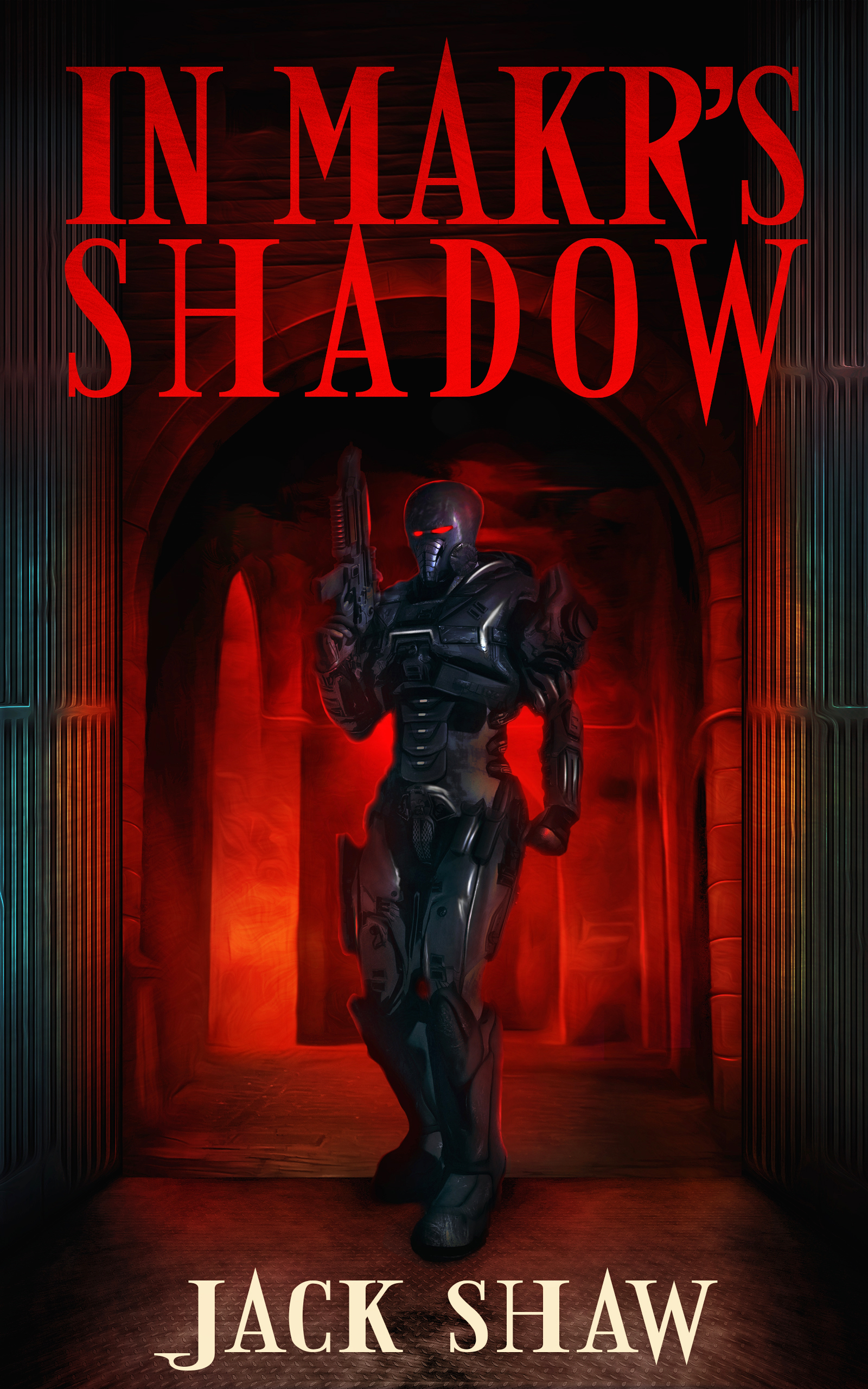
In Makr's ShadowThe cover of In Makr’s Shadow  is a dark representation of what confronts my heroes, who are mostly young adults seeing this world’s reality for the first time. In any dystopia, reality appears forbidding and hopeless.  The idea is to make a statement at the end–be it hope, regret, submission or rebellion. I chose “hope,” so all is not lost

In Makr’s Shadow. The enemy is not human. So, the destruction and deaths occur not only because of man indirectly but because of a machine–in this case an evolving artificial intelligence. The world is a realistic extrapolation of society today with one exception. We have placed an evolving artificial intelligence to save the world from us. And the sentient entity is doing just that by taking charge.

Ninety percent of the population see their world as the status quo, and see no reason to change it. Ten percent see reality and know the rest of humanity is content living in a fantasy world. Outside of Makr’s direct control, these people cope with reality the best way they can–by accepting, coexisting, worshipping and resisting it.

The Shadow People, about one percent of the population, form the only resistance, centered around Makr’s main server.  Battling Makr’s evolving machine creations seems a losing battle, but The Shadows People must continue the fight, hoping to win back control of their planet. Makr sees them as a minor annoyance but must deal with them before they affect His ability to control the rest of humanity–even if it means killing all of them.

The ongoing war is helpful in questioning other technologies, and in extrapolating the soft sciences that include psychology, sociology, anthropology and religion. More importantly, the war is a backdrop to see how the protagonists in my novel behave.

This blog may be a precursor to some blogs that have followed. Still good information I think in getting readers interested in reading between the lines of my book. There’s plenty, beginning with title. What do you think?

By the way, I’ve dropped the price a buck, and if you think you’d like to review it, I’ll send you a free copy. Heck, just for sending me an email, I’ll send you a free copy.

It’s never been my way to follow a tradition without trying to create one of my own. I am a writer. To truly be one, I need to have an audience. It’s easier on stage because there you are in front me and I feel your feedback. But that’s acting. I’ve been told I can “charm the nuts off a squirrel.” I say “Enough charm! Dig deep! Discover our ‘Twilight Zone’.”

Blogs are one thing, novels are another. I may not play by all the “rules,” but my heart is pure. I want to share ideas and explore who we think we are and what we really are.

Vicious Reality in David Mamet’s Pulitzer Prize-Winning GLENGARRY GLEN ROSS

Clip from the film. Instead of swimming with sharks, these real estate salesmen are vicious jackals and hyenas—feeding off each other, while moving in on each other’s kills—or leads, contracts, etc. These salesmen will do anything to close a deal. When their competitors, each other, or even contrary prey affect their ability to survive, they attack as suits them.

The Eagle Theatre’s production of GLENGARRY GLEN ROSS stunned the audience tonight and won them over with its portrayal of cutthroat, backstabbing, conspiring, conniving, lying and stealing, willing-to-do-anything real estate salesmen fighting to keep their jobs and/or avoid seeing one of their competitors walk away with an extra prize.

David Mamet’s Pulitzer Prize-winning play opened originally in London, and a year later on Broadway. Nominated for several Tony Awards, it won one. It also won several other awards, too many to mention in this forum. Later made into a film, GLENGARRY GLEN ROSS received much critical success despite the disappointing box office, proving that Mamet was not for the broader audience.

This production has it all, including rat-a-tat monologues and overlapping dialogues requiring fierce acting, raw language, weaseling, and smooth-talking characters. Naturally, violence follows when the characters are frustrated and unable to reach their goals. Director Ted Wioncek III and his ensemble cast guarantee vicious action over two days of the sales’ competition.

Intended to be a black drama, GLENGARRY GLEN ROSS is not a realistic representation of sales people today, but rather one that makes its point as each character reveals a certain primitive darkness. Hate, distrust, jealousy, worry, fear and anger abound. Congeniality, friendship and love are absent, except when someone hopes to gain an advantage.

It’s easy to see our characters reduced to scavenging, which includes a lot of positioning with claws bared, lashing out at everyone. We see the protagonists begin as a pack of wild animals, no longer able to compete in its environment. Faced with a goal that seems impossible to attain, they struggle and fight for survival. Together, they are hungry and desperate for game, feeling the pressure of being corralled, starved and desperate, knowing at least one of them most certain to die, and one shunned (fired).

The animal pacing is quick. The brutal landscape abounds with rocks, crevices and a few valleys, but never a flat field–or level playing ground. It is a mixed metaphor, I know, but it seems appropriate.

Mamet’s play raises some interesting questions as our “sales” animals roar, bark, and growl at each other.Do our characters ever recognize the consequences of their primeval behavior? It seems we, human animals, are capable of similar behavior in the face of high stakes, unfairness in the workplace, or even losing our ability to perform–to achieve as we once did.

However, when we raise the stakes too high or make achieving them impossible, do we put aside our values–our morality to gain an advantage? Are we simply predatory animals? What separates us from the beasts and makes us human? Animals in the wild avoid confrontation; they attack only when threatened in some way. When facing hostility, we return it.

How are we supposed to act when we see someone taking advantage of us or someone else? How bad does a situation have to be before we lose our veracity, our conscience or our ethics in seeking reward?

The answer is simple. There are times and situations that bring out the animal in us. Mamet, without saying it, reminds us that jackals will eat anything and hyenas have the most powerful jaws, but warns that jackals and hyenas are not as ferocious as some others are.

Lions, leopards and cheetahs will prey on jackals and hyenas if nothing easier to kill is around. Even vegetarians such as an ox or elephant can do them harm. The animal metaphor is mine, not Mamet’s, but I think the animal behaviors hold true.

The Eagle Theatre has certainly earned the name “South Jersey’s Premier Equity Theatre.” Its operation is a “class act” and a tough act for any professional theatre to follow.

Here, it again does not disappoint. From the moment you walk into the theatre you feel something big is about to happen. The bar is center stage (uh-oh, not the Wine Bar; that’s to your left as you walk into the theatre.) The Act I set background works well as bar or restaurant wallpaper, rich and elegant, but also is reminiscent of an old theatre or a circus drape.

The set was interesting and the lighting quick. The scene changes were in a total blackout, or so it seemed to the audience. The first act is shorter than the second—opposite of what you might expect—but gives the audience a perfect introduction.

The theatre company has done a remarkable job with a very tough work. David Mamet is never easy. His repetitive lines and overlapping sentences require the most talented actors. GLENGARRY GLEN ROSS is a different experience for many theatregoers.

The harsh language is appropriate in this play’s context, giving it a raw, primitive feel. Contemporary drama doesn’t get much better. It is an amazing acting feat to perform such rapid monologues with overlapping dialogues, but the cast was up to it. There was also a rhythm to the steady flow of words—the flow purposely interrupted by intense physical action like a cat lashing out.

This production’s worth the trip from wherever you live.

GLENGARRY GLEN ROSS
Written by David Mamet
Directed by Ted Wioncek III
April 25 – May 7, 2014
The Eagle Theatre
208 Vine Street – Downtown
Hammonton, NJ 08037
609-704-5012
http://theeagletheatre.com/

Originally posted by  for Stage Magazine.


Visceral Reality in Sam Shepard’s TRUE WEST

true westSouth Camden Theatre Company’s production of Sam Shepard’s TRUE WEST rocked audiences with its intensity and powerful performances primarily by the play’s leads, Jason Cutts as “Lee” and Patrick Alicarlo as “Austin”. The cameos by Breen Rourke and Kris Andrews provide the right touch as well.

Robert Bingaman’s set is perfect. Andrew Cowles’ lighting design contains beautiful sunrises and sunsets, and Josh Wallenfels’ great sound pulls us even more into the house in the desert.

TRUE WEST is the story of two brothers who come home to where they grew up–about 40 miles outside of Los Angeles—in one of the many desert family communities. The brothers share little in common: Austin has lived a “normal” life having gone to college, gotten married, etc., while Lee has survived the desert and in life, primarily by being a thief. Dad is a drunk and lives somewhere in the Sonoran desert near Juarez, Mexico.

While his mother is on an Alaskan cruise, Austin, an accomplished screenwriter from the city, is house-sitting for her, and his brother drops by to prey on the neighbors’ household appliances. Austin objects to Lee’s intentions, but eventually allows him to stay–if he is out of the house when a film producer arrives that afternoon. Lee returns from a heist while the producer is still there. Instead, he talks the producer into a playing golf and looking at an outline based on an idea he has for a screenplay. Austin helps his brother with the outline, but not without humiliating his brother by overstating his own successes.

The next day, Lee returns jubilant after gambling on the golf game to get the producer to drop Austin’s project and produce his.

You can imagine the sparks that fly next. Sam Shepard is one of America’s most prolific and celebrated playwrights with his work fitting a variety of stages. Shepard, known for narration in his plays, uses short quips and retorts to send his message this time, but the message is as powerful as always.

Why does Shepard place his story about sibling rivalry among other things in the desert location? It seems distance and their mother may be buffers between the brothers’ polarity. They seem to be trying, quite literally, to bust each other’s head in. Lee, of course, leaning more toward his dad’s side, argues vehemently that Austin couldn’t survive in the desert or steal a toaster. This time, Austin is on the defensive. Each tries to emulate the other, but there is no connection. Is that the message? Maybe we are supposed to be who we are for ourselves and no one else. Or, do we need a buffer, too?

Although their father never shows up, he is at the heart of the play. One brother refuses to be anything at all like his father, while the other is already showing signs of the same pattern in his life. Shepard’s plays continually pick at the father-son relationship. In this case, the sons are “bound by fate” to follow the father however dismal the future.

Despite Robert Bingaman’s realistic scene design (and it’s a good one), the emotional intensity of the brothers’ battles ensure that this production is not realistic, and stays on point. Even with the outstanding sound and lighting effects that draw us into the scene. We are stuck there as the brothers are, tied to home, the last place we knew who we were. If anyone yelled at us, the way these two carry on, we’d leave the house or call the police.

While the play could be played with less volume —especially in a small house—and still work, I’m glad director Christopher “Jumbo” Schimpf chose to go with the playwright’s intention, which I think, gives energy to his message.

What we might think, Shepard realizes and makes us see. Sam Shepard’s plays, like any good playwright’s, are not about the stories he or she tells.

TRUE WEST is full of symbols, motifs and meaning, but it is also quite entertaining. It is a dark comedy, but so full of emotion that it doesn’t feel like it. Remember, it is not a farce, but a Human Comedy, so you can expect it to affect you deeply. Bring tissues. The play is funny, sad, angry and full of despair at times.

The South Camden Theatre Company production of TRUE WEST does a great job of reminding us that we, too, can fall victim to what people say, and that we should strive to be true to ourselves. The acting performances alone are worth the price of a ticket, but you should go for the whole deal.

TRUE WEST
Written by Sam Shepard
Directed by Christopher “Jumbo” Schimpf
April 25 – May 11, 2014
Fridays and Saturdays at 8:00 p.m.
Sundays at 2:00 p.m.
South Camden Theatre Company
Waterfront South Theatre
400 Jasper Street
Camden, NJ 08104
866-811-4111
http://www.southcamdentheatre.org

Originally posted by Jack Shaw for STAGE Magazine.

Check out this video with Gary Sinise and John Malkovich.

What Qualifies a God?

This is an important question. Can we create a god? Not in our minds, hearts or souls, but in science. First, this is not a religious debate. Second, I don’t wish to offend anyone with this rhetoric. The big question is can we create a deity, or something that defines our definition and criteria? Some would say it’s all in our minds… We still need a criteria.

How about we play with the definitions–just those that appear in our society today?

We have gods and a god concept in our minds. Our definition of a personal god is easy; we are taught what defines the presence of one in our lives. Most of us believe in something whether it is spiritual or science, i.e., the Christian vs the atheist, or it could Islam versus the Unbeliever  It’s not really that complicated is it?

Ironically, some people know the definition because their religion tells them, but allow “other gods” to exist in their imaginations–not believing but accepting another god concept for a moment.

We all will accept that a character on a screen, in a book, or even people in reality may be god-like totally separate from our beliefs. For example, super heroes–Thor in particular is a demi-god; Hercules is also. They come from the past but we accept them for the sake of a good story. Maybe there’s more.

Mythology, of course, is full of gods, many of them the basis for a people’s religion. Some doctors have a god-complex. Kids are told through stories that some beings are superior in such a way as to be gods. Fantasy tales, for example.

Science fiction plays with the concept as well. It depends on how we define god. Belief systems have a criteria, or you wouldn’t believe. Sure, we all believe in truth, but we “humanize” everything. As we do so, we are pretending we live in a different world. From talking to our pets to reincarnation–a whole different matter.

Then, there is the concept of power. Why do some want it or need it?

Who wants to be in charge of everyone or be responsible for everyone?Those who really believe they are gods are institutionalized away somewhere away from us sane people.

Is it supreme intellect, the ability to create miracles, or have super powers, or by virtue of being a more powerful species overall?

The last would make us all gods, wouldn’t it? It is the basis for many myths that include two worlds, one stronger and more powerful and a lessor one, subservient to the first.

In Makr’s Shadow, humans save their planet from self-destruction. To do so, scientists create a super cyber server by combining the power and data available in the world in one place. The idea is that the machine can make all the hard decisions needed to save the earth so neglected by humanity. Unwitting, they have created a monster that believes he is a god–the only one on the planet. Nothing on earth is more powerful. I didn’t set out to discuss the question in my novel. The idea and discussion evolved as I imagined the society, and the splintered groups, in particular, that go separate ways. While ninety percent of the population are under Makr’s spell, ten percent are not.

These humans are unpredictable. It’s not belief or disbelief in a deity; they resist as humans do–to change. However, that group naturally splinters into smaller groups of varying beliefs and other reasons, some being just survival. This splintered society is our society.

We are all different, but that’s about to change when a man appears who is unique to both groups. Is he a freak of nature, a missing link, or a messiah? Makr creates memories and realities proper to run a Perfect Society. In this society, there is no dissention, no laws, no feeling or thought that cannot be controlled and managed.

That is, except for one man–an anomaly named Harry Bolls who can see through illusion. He doesn’t know how or why he is able to do this, and he has lost a chunk of memories. It is enough to send him on a quest for the truth.

Is the world around us real or an illusion? Is reality what we see, we think we see, or what we know? And, how do we know it?

Whereas the omniscient Makr, as the most powerful and intelligent being on the planet believes Himself to be a god. In Makr’s Shadow, the truth is not so simple. Anymore, and I give away the ending. Rather than face religion head-on, I tried to create a satirical situation begging the age-old question: which came first the chicken or the egg? Or, in this case, Makr’s goal is to make humanity believe, in fact, that they are Bios–simply a weaker species of machine using a biological design.

Why doesn’t Makr delete the humans and clear the planet in favor of better, more controllable inhabitants? Human behavior  does not compute; it’s not predictable. Could it be he wants to know all that the humans know before he eradicates the entire race? Still he has to fight those who attack his PerSoc.

Do we know the minds of the lower species? In this case, Homo sapiens sapiens. What happened to Homo sapiens neanderthal? We can only speculate, but the fact remains, our species survived and theirs did not.

In Makr’s Shadow, the social sciences are at work, too. As is the psychological impact of living in such a society. Would we one day be willing to live in a world that had no consequences, or design a life of our choosing? It’s tempting. Some humans worship Makr as a means to personal survival, believing that a superior being must be merciful. Even the splinter groups recognize Makr’s superiority and power. However, they are only admitting that there is a sentient being of superior intellect, strength and power is worthy of the highest respect.

If we compare Cyber and Bios as separate species, which they are obviously, there are differences. Makr has created a “race” of Cyber or specialized cyberts. Each is task-oriented; each one in its place. Cyber appear superior to Bio machines in intellect, adaptability, strength and durability. But no human is exactly the same (except in the subset) and so unpredictable. A human’s place is where he or she chooses in the theoretical world. Unfortunately, that isn’t always true in reality.

Is Makr a god? For his Cyber maybe. The rest is for you to decide.

In Makr’s Shadow is available wherever e-books are sold.

Giant Robots Are Passé

Metropolis_poster For novels that is… Some who publish young adult books still use them, I suppose. And, graphic novels. Movies, on the other hand, get away with giant robots flying around the sky destroying everything in their paths.

A very smart scientist–an off-the-chart smart scientist–found a way to work around the effects of gravity, the pull of the sun and other space objects revolving around it, and some basic rules of aerodynamics.

We don’t bother to count errors in the science of an action film. Robots can fight on the ground, in the sky and even in space. Spacecraft or other flying machines stop in mid-air so we assume they are equipped with anti-gravity devices. Ordinary machines evolve into superior, “cool-looking” warriors.

It’s exciting…in film.

Unfortunately, if writers do write something comparable in a science-fiction novel today, it would most likely be trashed or sold to Hollywood, but not published traditionally. (Okay, maybe it can pass for a young adult novel, but that’s the market anyway.)

With today’s economic conditions, most any novel dealing with the above would be considered hackneyed by the editors, and I can’t say I’d disagree. Robots, with the exception of microbots and other variants, have lost the top spot in science-fiction genre literature.

Cyber warfare is different. Here we are still dealing with a human-made attempt to create a helpful artificial intelligence and that becomes sentient. What happens after it is created and placed is the story.

So, I broke the publisher’s cardinal rule, knowing that the conflict, war against machines, is passé, over with, and done in. But, I did it anyway. I used the Cyber Bio War as the backdrop for my novel. What my characters experience is an unwinnable war against an evolving enemy with not just some, but all of the resources. Yet, the continue the fight. Humans are and always will be inferior with the usual weaponry, but they will not give up their humanity.

After I extrapolated existing science and societal trends I had to go there–to that world I created. Good writers can break the rules of good grammar in telling a story. Why can’t I explore content in the same way.

In Makr’s ShadowI broke the rules of the latest publishing trend and paid the price, publishing an e-book instead. But I still think it is worth it.

Robots in science fiction literature seem to be window dressing, an accepted part of future society, but there’s always the exception. A different use, an unusual place. Creative fortune.

However, my “robots” are different. Cyberts, my “robots,” are mobile extensions of a central evolving artificial intelligence. Cyber are not the automatons of the past but a new accepted, sentient species–a race of thinking machines–machines that can do anything a Bio can do, only better.

At the moment, these Cyber are effectively maintaining the planet and pacifying its inhabitants by waging war on dissidents.

Jurassic_Park_3DWe see a lot intelligent machinery in films–especially with the Marvel and DC comic book superheroes. Who else could giant robots fight? Normal humans would be crushed in a minute. The story would read like a metallic Jurassic Park, except there would be no eating the dead. I’ve yet to see a robot that does that. Massive destruction, yes. Eating its victims, no.

Film producers want to create images that astound, not literature that fascinates and discusses the way we interact with our technology. There are a few exceptions like Gravity Apollo 13and a few others that deal with existing technology are still able to do that. Most films that pretend to be science fiction contain little plot or character development.

Now-a-days, most science fiction is about the effect of new science discoveries or technology gone awry, i.e. the atomic bomb. Still, the weird variations get in. You know them when you see them and put the book down, sorry you picked it up in the first place.

The definitions and types have grown far and wide with the interest and imagination of those who read SF. Still, the genre experts (call them publishers) say science fiction literature should focus on the “higher levels” of hard science for the most part; however, some publishers like to throw in fantasy (personal choice?), wars fought against superior alien technology and war’s that end the world, leaving a few survivors. All of these conflicts and situations, too, are obvious and overused.

However, there was a time when robots (uncool now) served in the background and often played a leading role in a novel of ideas. Isaac Asimov started a trend in 1946 when his I, Robot was published. It was also made into an science fiction action film with Will Smith.

Asimov created the Three Rules of Robotics:

  1. A robot may not injure a human being or, through inaction, allow a human being to come to harm.
  2. A robot must obey the orders given to it by human beings, except where such orders would conflict with the First Law.
  3. A robot must protect its own existence as long as such protection does not conflict with the First or Second Law.

For the most part, these rules have been respected by colleagues whenever robots are in contact with human beings.

In Makr’s Shadow was influenced by the work of Isaac Asimov (a highly underrated author) and Kurt Vonnegut, Jr. (a mainstream writer). Both were writers of the literature of ideas. I hope I’ve managed to merge the essence of each, and have done so respectfully. CatsCradle(1963)

Unlike Asimov, who wrote science fiction and was delighted by it, Kurt Vonnegut, Jr. denied that any of his fiction fit in the science fiction genre, when all of his novels have elements of SF by definition, and easily fit a definition of SF very well.

It may have been an act, but I think he wanted to be accepted totally in the mainstream rather than appear side by side with that SF trash–genre fiction. You know, the kind that had aliens or robots in it?

Because it’s satire, does that make it mainstream literature. Vonnegut made fun of science fiction in The Sirens of Titan, but if you look at all his books you will find they either fit the definitions or contain elements of science fiction. And, unless he’s poking fun, you won’t see any robots. Ironically, his imaginative and thought-provoking novels make excellent cases for writing soft or social science fiction.

With the exception of Cat’s Cradle (atomic bomb), he uses the soft sciences of psychology, sociology, economics, history, time travel, and alternate realities or universes to make his point, as opposed to the “hard” sciences like chemistry, physics and biology.

In Makr’s Shadow, the ongoing conflict is the background in the same way as Vonnegut’s parody of science fiction masks his underlying idea. That one day we will develop artificial intelligence one day is certain. How we choose to use it will be more important than the development itself.

My dystopian digital novelIn Makr’s Shadow is a rock and roll, roller coaster of action, suspense, humor and character development– highlighted with positive values–and, if you can believe it, an evolving family.

According to Tricia Johnson, The Word Weaver, UK, In Makr’s Shadow is ” a superb read…edge of seat stuff until the very end!!”

And, she should know because she helped fine tune it. The ending is, of course, to be kept secret; however, it can be said the story is more about people than the machines.

Science Fiction: What’s The Big Deal?

brainThe big deal is this: representing science fiction as a jumbled, juxtaposed mass of gee whiz elements, great for special effects, is just not fair! And, we see it all the time in blockbuster science fiction films. The obvious intention being to entertain, but to call what we see science fiction or imply, infer or state that it is good or great science fiction is wrong. Good science fiction, whatever the definition, involves the use of the brain to process ideas as well as emotions. Of course, that’s why it’s called the “literature of ideas.”

Although there are more authoritative sources, one only needs the online source, Wikipedia, to get an idea of the broad base of science fiction definitions, and not be overwhelmed. There are two separate pages: 1) literature genre and 2) film. Check out this link from the University of Michigan about the various types of science fiction literature, and this link from SciFi Lists.

As broad as those definitions are, the best to me seems to be the notion that science fiction (SF) genre exists as a way of communicating with society about humanity’s relationship with science and technology.

In Makr’s Shadow is a story about what happens a man creates a machine smarter and able to evolve faster than all humanity, but it means more than that. The story is an entertaining conveyance of a deeper message. Kurt Vonnegut, Jr. uses The Sirens of Titan, not only as a vehicle to parody science fiction, employing as many SF devices as possible, but also to discuss something else he thinks is more important. The deeper question is not the parody (although entertaining), but contained within the whole piece. For both novels, even if you don’t understand the underlying message, you will still be remarkably excited by the adventures.

In Makr’s Shadowthe obvious man against machine conflict sets the stage to say something more. For humanity, the obvious underdog, the fight against the machines seems hopeless, so what is the real conflict here? It has to be something deeper.

Violence (human against human) exists in every quarter of society today, but in my future world–In Makr’s Shadow, technology is the villain, so most of the violence is machine against man and vise versa. However, that’s where it stops.

The world we see is in the middle of war against machines, but the war is not what propels the action. Harry, an Insider, who has the ability to see through the fantasy to reality, is the impetus. His drive to know the truth affects the world.

The obvious is not so obvious anymore. The war is an element as entertaining as it may be; however, is not the most important idea…although a reader could be content reading the novel as a simple adventure tale.

There are human questions like how others perceive us, how we see ourselves and what is best for us–or for others are what we struggle with everyday. What is it we have over the machines that make us at least as powerful?

When you add the “evolving artificial intelligence” to the equation, the answer is far more complicated.

The question becomes about power: who has it and what do we do with it?

The machines are limited by logic. We, humans are not. Human behavior is irregular, but not a defect. We have the ability to be spontaneous; the machines do not. There are quite a few moments where the conflict is man against man, but that happens in any fractured and stressed society–like the one we live in. Here, In Makr’s Shadowthe conflict really becomes man against himself.

Humans have psychological and sociological reactions to this dark reality. Some become twisted and hateful, some grow in positive ways, becoming leaders and even heroes. Some conflicts are baser as a young woman fights back against a human who tries to rape her, and the violator is punished immediately without trial or hearing.

TheSirensofTitan(1959)Sexuality is generally treated with satire, and in a love story, and yet the novel’s essence is about discovering truth (why I am the way I am). “What are we?” is a trivial human question in comparison, but still important nonetheless. In Kurt Vonnegut, Jr.’s The Sirens of Titan, he explores the sophomoric question of purpose in the universe. Why do we exist?

Science fiction can explore many issues–some quite basic–and some quite deep. It can provide a platform for addressing and discussing sensitive issues we may not want to confront head-on. Using extraterrestrials in a story allow us discuss certain aspects of society we might find uncomfortable like racism, sacrificing a few to save many, positive and negative effects of cloning, the same of religion, etc. It can teach like a fable or a fairy tale. Often, SF is exactly that. In fact, In Makr’s Shadow, could easily be considered a fable or fairy tale with science as the magical force that affects everyone.

In fighting to save their world and their humanity, my heroes, physically and mentally, must confront the world they nearly destroyed. Once they understand, they don’t know what they can do about it. Why would anyone give up a world so perfect? It’s about choices we make, and about what makes us unique in the universe–even unique among other humans.

The exciting “action” is in the backdrop of a war against lethal machine-made weapons and the artificial intelligence that created them. In fighting what seems to be an unwinnable war, humans face their own demons–their own nature.

The thought-provoking underlying question is: are humans worth saving? They face their own splintered society, face universal fears and persevere. The story twists and turns as our heroes uncover myths of their own making.

And, the ending…well, let’s just say it should surprise you. If not, e-mail me and let me know. The best news is that the price of this fantastic ebook is a mere $2.99 at Amazon, Barnes and Noble, Kobo and other retailers of ebooks. You can also go direct to Smashwords.com and download it in virtually any format.